
Historical and Economic Rationale
Central Asia is a region comprising five former Soviet republics situated in the heart of Eurasia: Kazakhstan, Kyrgyzstan, Tajikistan, Turkmenistan, and Uzbekistan. This area is located on the lands of the former Silk Road, which served not only for the exchange of goods but also for ideas and technology.
Although these lands are often associated with nomadic culture or trade centers, they actually boast a rich scientific and intellectual tradition. Regional cities were centers of learning in the Islamic world, where mathematics and astronomy flourished. Later, for decades, the region served as the industrial, military, and scientific base of the Soviet empire. Important centers focused on the aerospace and aviation sectors were located here.
Today, these countries are actively seeking new development paths and diversifying their resource-based economies. It is precisely within this rich historical and intellectual context that Central Asia is undergoing a transformation, aided by special technology zones.
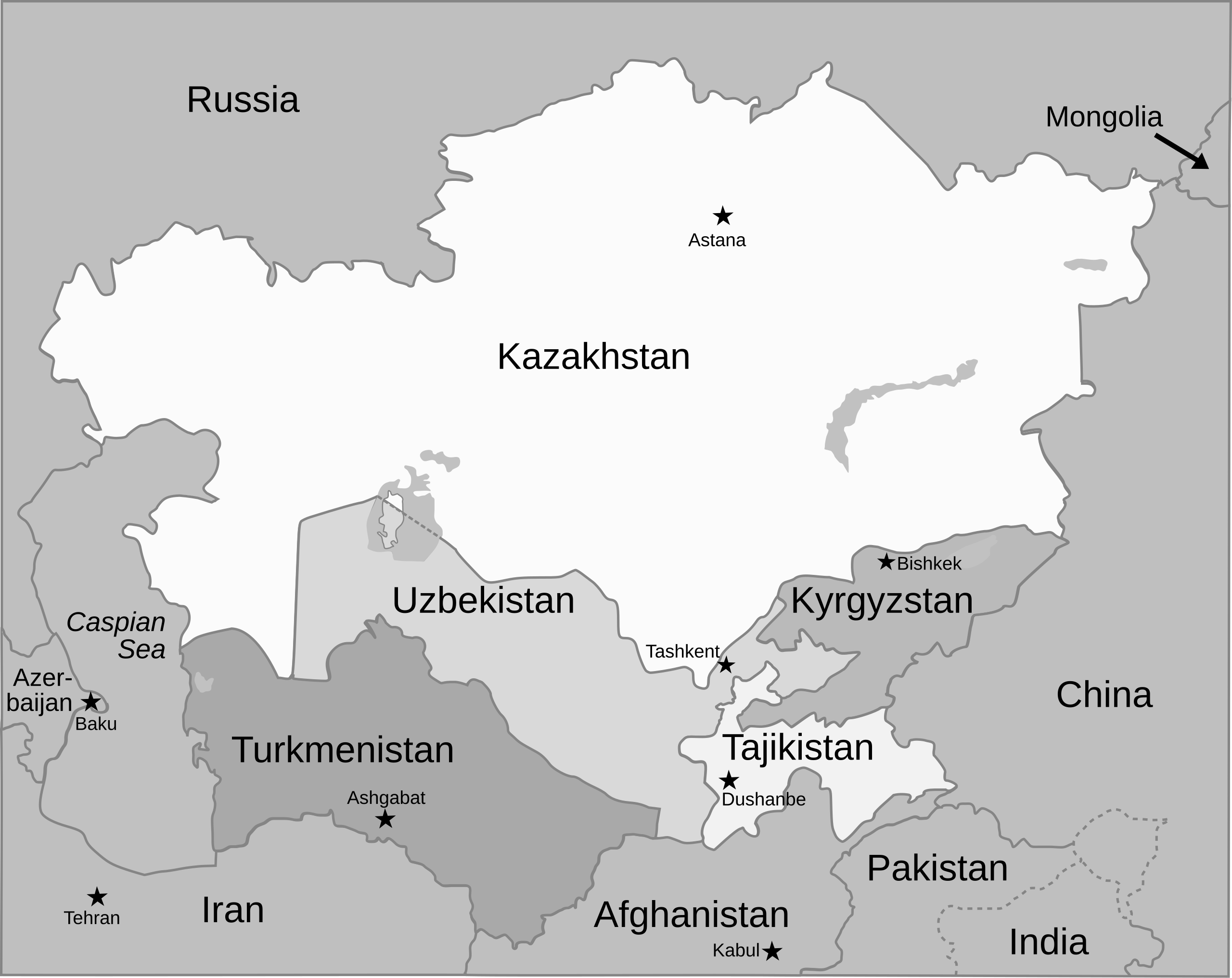 The photo illustrates the five countries of Central Asia / wikipedia.com
The entire region is landlocked. Kazakhstan, Turkmenistan, and Uzbekistan are larger countries, rich in natural resources, especially natural gas and crude oil. Tajikistan and Kyrgyzstan are poorer countries, with some mineral resources, and the majority of their territory is covered by mountainous regions.
To the north, the region borders Russia, with which it maintains strong economic and, to varying degrees, political ties. To the east, it borders China, with whom the countries cooperate on transport corridors for the project to and from Europe. To the south, the region borders Afghanistan and Pakistan, which simultaneously pose a security challenge and serve as important transit corridors leading to the Indian Ocean ports. To the west, the Central Asian states are connected by the Caspian Sea, Azerbaijan, Georgia, and Iran, facilitating access to European and Middle Eastern markets via the Trans-Caspian Route and the North-South corridor.
Definition of Technology Zones
Technology zones (hubs, parks) evolved from traditional Special Economic Zones (SEZs). In comparison, a technology zone is more dynamic, talent-oriented, with the goal of creating a knowledge-based economy. An SEZ, on the other hand, is primarily a passive zone of tax relief with physical infrastructure (factories, warehouses), focused on industry.
The objective of creating technology zones is to attract capital, talent, and innovation. They offer preferential conditions (tax, visa), infrastructure, and regulatory frameworks. They are not synonymous with an ecosystem. Zones create favorable conditions for companies, but the interactions between companies, accelerators, investors, talent, and universities are what build a full ecosystem. Thus, the zones are a foundation, constituting a formal element of state policy that creates the groundwork for a much broader technological ecosystem.
Accelerating Digital Transformation
The technological zones in Central Asia are not a random trend. They result from common factors across the region's countries. This trend is sustained by the strategic policies of local governments and geopolitical events.
Economic Diversification
The region is striving to diversify its resource-based economies towards a knowledge- and service-based economy, reducing dependence on oil (Kazakhstan and Turkmenistan), gas (Kazakhstan, Turkmenistan, Uzbekistan), minerals (Kyrgyzstan, Tajikistan, Uzbekistan), and cotton (Uzbekistan, Turkmenistan). Over 52% of the region’s total exports consist of energy resources, highlighting the significant dependence of the region, particularly for Kazakhstan and Turkmenistan. Long-term state restructuring strategies for diversification are outlined in plans such as Uzbekistan-2030 and Kazakhstan-2050.
Population Growth and Employment Pressure
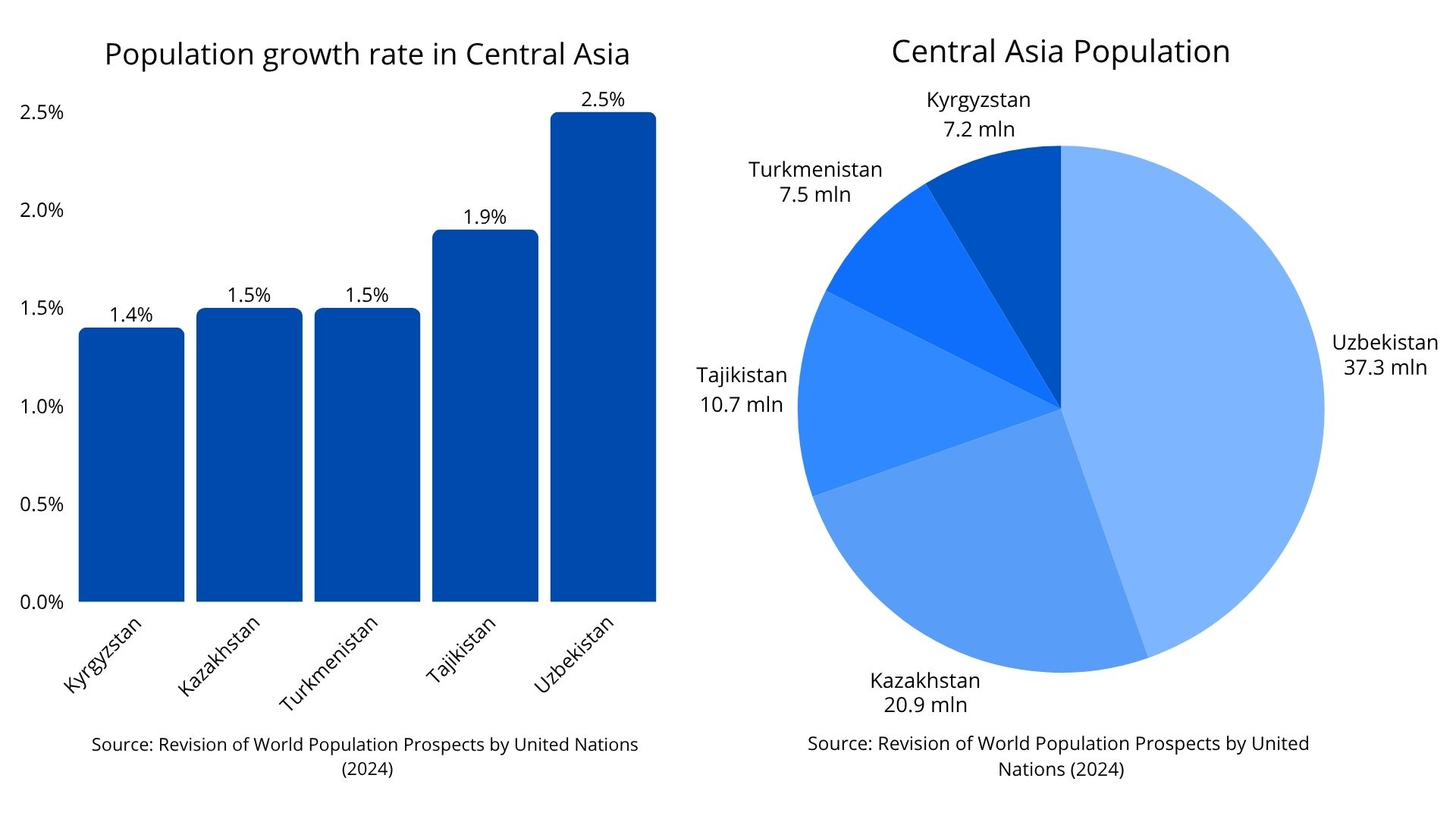
In contrast to aging Europe, Central Asian countries have very young and rapidly growing populations, guaranteeing a constant supply of labor. In Central Asian countries, over half of the inhabitants are under 30 years old. This dynamic natural growth necessitates the creation of hundreds of thousands of new jobs annually. The scalable and export-oriented IT sector has become a tool for governments to reduce youth unemployment and build a modern economy.
Low Labor and Energy Costs
Low wage rates and relatively cheap and clean energy-especially hydropower in Kyrgyzstan and Tajikistan, and gas-based in Kazakhstan and Turkmenistan-create competitive conditions for outsourcing companies and data centers. This allows the region to compete on cost with Eastern Europe or India.
Country | Kazakhstan | Kyrgyzstan | Tajikistan | Turkmenistan | Uzbekistan |
USD/MWh | 37 | 6 | 6 | 79 | 49 |
Table of average electricity generation costs in US dollars based on Average cost of generation and range of retail electricity prices in Central Asian countries, 2021 / iea.org
Geopolitical Catalyst
Maintaining neutrality regarding the Russian-Ukrainian conflict in 2022 allowed for a massive influx of specialists and entrepreneurs migrating from Belarus, Russia, and Ukraine. This is a reversal of the situation that occurred immediately after the collapse of the Soviet Union, when, in the 1990s, educated ethnic Russian personnel, in particular, left the region for Russia in search of new opportunities. According to estimates from the Central Asia University, the number of people who left Russia for Central Asian countries in 2022-2023 was approximately 265,000. This included 65,000 to Kyrgyzstan, 75,000–100,000 to Kazakhstan, and about 100,000 to Uzbekistan. Geographical and cultural proximity thus provided an injection of talent, knowledge, and capital for the region.
Post-Soviet Engineering Traditions
The Soviet legacy left a solid scientific and technical foundation in Central Asia, which today serves as a starting point for the region's digital transformation. Kazakhstan was an important center for the aviation industry. The Baikonur Cosmodrome, a symbol of the Soviet Union's space ambitions, is still operational and attracts investments related to space technologies. Uzbekistan developed physics and mathematics institutes, educating generations of scientists. Soviet polytechnics in Kyrgyzstan and Tajikistan supplied engineers capable of carrying out complex industrial projects. Today, Kazakhstan and Uzbekistan have the largest number of universities in the region (116 and 222, respectively) and occupy high positions in the WT20 Education Ranking 2024 (Kazakhstan - 43rd, Uzbekistan - 63rd).
Country | Kazakhstan | Kyrgyzstan | Tajikistan | Turkmenistan | Uzbekistan |
Number of universities | 116 | 74 | 13 | 23 | 222 |
Position in the WT20 Education | 43. | 64. | 87. | 169. | 63. |
Number of universities in Central Asian countries (as of 2025) and position in the Education Rank WT20 2024 / stat.uz, stat.gov.kz, edu.gov.kg, turkmenistaneducation.info, free-apply.com, worldpopulationreview.com
The importance of the Russian language remains significant: many courses and laboratories in the polytechnics and technical institutes of Kazakhstan, Kyrgyzstan, and Tajikistan are conducted in Russian, facilitating access to scientific literature and regional collaboration. In addition, a substantial share of students from Central Asia continues their education at Russian universities (212,000 students from the region in 2025), particularly in STEM and medical fields, thereby strengthening regional scientific ties and reinforcing the influence of the Soviet education system on the contemporary technical workforce.
Globalization of Services, Growing Importance of Cloud and AI
The rapid development of cloud technologies, automation, and artificial intelligence has created a global demand for highly scalable IT services. Companies from Central Asia can provide these services remotely, without the need for a physical presence in major markets, facilitating the region’s integration into global value chains and accelerating the export of digital services. In Kazakhstan and Uzbekistan, modern technology hubs such as Astana Hub and IT Park Uzbekistan are emerging, employing thousands of IT specialists and driving dynamic growth in the export of digital solutions. Local companies undertake projects for clients in Europe, the USA, and East Asia, offering services in cloud computing, data analytics, and AI solutions. At the same time, the development of digital infrastructure, including data centers and broadband networks, enables the provision of services on an international scale.
Characteristics of the Region’s Countries
The technological zones promoted in Central Asia differ in model and incentives, reflecting the regional diversification of strategies.
Country | Kazakhstan | Uzbekistan | Kyrgyzstan | Tajikistan |
Zone | Astana Hub | IT Park Uzbekistan | Hight Technology Park | IT Park Dushanbe |
Number of Residents (Companies) | 1500+ | 2800+ | 500+ | 40+ |
A Comparative Overview of the Individual Technology Zones Based on 2025 Data.
Kazakhstan is the country that invests most intensively in IT and the digital economy. It has a very advanced and mature ecosystem. The country boasts the first-established Unicorn (Kaspi.kz) in the region. The Astana Hub, the main technology zone in the country, has been operating since 2018. The Kazakh ecosystem has a highly developed FinTech sector and is now focusing on the development of AI.
Uzbekistan is the most populous country in Central Asia. The country has a strategy based on the mass training of personnel and the attraction of international outsourcing. The state has been carrying out reforms and opening up to the world since 2016. The IT Park Uzbekistan technology zone was formed in 2019. It is scaling very dynamically and is strongly supported by the government apparatus.
Kyrgyzstan is a smaller country with the smallest population in the region. The technology zone has been operating here since 2011. It creates an extraterritorial jurisdiction within the High Technology Park (HTP), which covers the entire country. It does not condition the applicable incentives on the company's physical location within the country. There is visible inspiration from a similar solution in Belarus.
Tajikistan is the smallest and poorest country in the region, and it is in the initial phase of ecosystem development. The IT Park Dushanbe was opened in 2024. The country plans to utilize its rich hydropower resources to create cheap AI data centers.
Turkmenistan is the country with the highest degree of state control in Central Asia. The economy is strongly dependent on gas. There is no open technology zone, and initiatives concentrate around the digitalization of the state.
Challenges
The development of the technology sector in Central Asia also encounters significant challenges. In many countries, the Venture Capital market is still immature , which limits the possibility of quickly financing startups and scaling innovative projects. Outside the capitals, internet infrastructure is often insufficient or costly , which hinders the development of technology companies in peripheral regions.
Kazakhstan stands out with a high internet penetration rate of 92.3% of the population, with an average speed of 53.86 Mbps, ranking the country 94th in the world.
Uzbekistan achieves 83.3% internet penetration , and the prices and speeds of internet packages allow for relatively broad access for residents.
In Kyrgyzstan and Tajikistan, a large part of the population still remains offline, and infrastructure in many peripheral areas is insufficient.
Turkmenistan performs the worst, where only 2.6 million people use the internet, speeds are very low (an average of 4.31 Mbps), and the country ranks 161st in the world in terms of network quality.
There is also an educational gap in areas important for a modern digital economy, such as artificial intelligence, data analysis, or cloud technologies , which requires intensive training programs and support for local talents. Additionally, regulatory, corruption, and bureaucratic risks can slow down the development of technological ecosystems and limit the freedom of companies to operate.
Prospects
Despite significant challenges, Central Asia is entering a phase of intensive, coordinated reforms. The countries of the region are actively striving to mitigate their weaknesses.
In the area of financing, new funds supporting startups and initiatives increasing access to capital are being established. An example is the Dive into Silicon Valley program in Kyrgyzstan, enabling startups to establish contacts in Silicon Valley. State grants are being made available-financing participation in Draper University or Deep Tech programs-as well as preferential tax conditions (0% CIT, 0% VAT). Activities connecting local entrepreneurs with foreign investors are being organized with increasing frequency.
In the area of digital infrastructure, investments are being made in broadband networks and cooperation with international operators (Huawei or ZTE). Some projects are co-financed by international institutions, including the World Bank. The countries of the region are developing alternative fiber optic routes (currently 95% of Kazakhstan's international traffic is routed through Russia) and satellite technologies, such as Starlink. Projects are being carried out within the framework of the EU initiative “Connectivity for Central Asia”.
In the area of human capital, intensive training programs in IT, AI, and Data Science and scholarship systems for technical students are being developed. Although the region possesses strong engineering traditions, the existing education system does not cover the needs of the dynamically growing digital economy. Training initiatives, such as Tech Orda in Kazakhstan or Million Programmers in Uzbekistan, which increase the number of specialists ready to work on projects, serve to fill the competency gap.
In the area of the regulatory environment, the countries of the region are simplifying regulations and digitalizing administration. The emerging special technology zones accelerate company registration and facilitate tax settlements. The development of e-administration limits the need for contact with officials. Easier access to permits and licenses enhances regulatory predictability and increases the region's attractiveness for foreign investors and developing startups.Summary
Central Asia, which historically served as the Silk Road for the exchange of ideas and technology , is today undergoing a massive and strategic transformation from a resource-based economy to a knowledge-based economy. The countries of the region have created effective, yet distinct, operating models. Success is largely based on tax incentives, young human capital, and a geopolitical catalyst. Central Asia is effectively changing its identity, becoming a real competitor to traditional outsourcing markets, solidifying its position as a stable, digital gateway to Eurasia.
Summary
Central Asia, which historically served as the Silk Road for the exchange of ideas and technology, is today undergoing a massive and strategic transformation from a resource-based economy to a knowledge-based economy. The countries of the region have created effective, yet distinct, operating models. Success is largely based on tax incentives, young human capital, and a geopolitical catalyst. Central Asia is effectively changing its identity, becoming a real competitor to traditional outsourcing markets, solidifying its position as a stable, digital gateway to Eurasia.
I treat this article as the beginning of a cycle of articles about Central Asia, in which I will detail the situation of the technology zones in each country, their successes, challenges, prospects, and the condition of the entire technological ecosystem.
Tags:
[24.kg] Predlagaetsya sdelat rezhim Parka vysokikh tekhnologii bessrochnym.
[astanahub.com] (General Astana Hub information and articles).
[caspianpolicy.org] Russian Relokanty: Central Asia’s New Digital Nomads.
[caspianpost.com] Tajikistan to Launch First Hydropower-Powered AI Data Center in Central Asia.
[d4dhub.eu] Connectivity for Central Asia Action (C4CA).
[digitalbusiness.kz] Kak teoriya eksponentsialnogo rosta legla v v osnove Astana Hub.
[economist.kg] PVT obiawil konkurs dlia startapierov: pobieditieli otpraviatsia v Kriemniievuiu Dolinu za inviestitsiiami.
[gov.uz] Strategy of Uzbekistan 2030.
[htp.kg] (Official HTP website).
[it-park.tj] (Official IT Park Tajikistan website).
[it-park.uz] Central Asian Innovation Hubs: New Prospects of Promoting Regional Capability.
[it-park.uz] Uzbekistan Showcased Its Growing IT Potential at GITEX Global 2025.
[it-park.uz] Uzbekistan strengthens position as IT Hub: Over 280 export-oriented companies join IT Park in five months.
[it-park.uz] Uzbekistan emerges as a key destination for IT specialists and foreign companies.
[khovar.tj] V Seule obsuzhdyon proekt stroitelstva kompleksa IT Hub Dushanbe.
[kongresnowejmobilnosci.pl] Hub technologiczny – jakie korzyści daje centrum innowacji?
[newscentralasia.net] Building IT Competence: Empowering Turkmenistan's Digital Future.
[osw.waw.pl] Kryzys jako szansa. Nowy etap relacji UE i Azji Centralnej.
[osw.waw.pl] Niech żyje młodość. Demografia państw Azji Centralnej.
[outsource.gov.uz] Uzbekistan Strengthens Position as IT Hub: Over 280 Export-Oriented Companies Join IT Park in Five Months.
[pb.pl] Azja Centralna zyskuje przez wojnę na Ukrainie: rosyjskie firmy przenoszą się do regionu.
[regard-est.com] Kyrgyzstan: next technological hub in Central Asia.
[silkroadtcdisrupt.com] Silk Road TC Disrupt.
[soft-fx.com] Kyrgyzstan kak novyi Fintekh-khab Tsentralnoi Azji.
[studium.uw.edu.pl] Kirgistan a migracja Rosjan do kraju.
[tax-legal.uz] (Uzbekistan Tax and Legal information).
[techcrunch.com] Meet Uzbekistan’s first unicorn: e-commerce startup Uzum
[the-tech.kz] Kak razvivalas IT industriya Tadzhikistana v 2024 godu: glavnye sobytiya.
[thediplomat.com] Is this Central Asia’s green energy reckoning?
[timesca.com] How the Kyrgyz Republic's High Technology Park is Quietly Building a Global Digital Powerhouse.
[timesca.com] Kazakhstan Adds Over 4,000 New IT Companies in Two Years Amid Tech Boom.
[timesca.com] Kyrgyzstan's High Technology Park Confirms Indefinite Preferential Tax Regime.
[timesca.com] Splitting the Flow: How Central Asia Can Bypass Russia in Internet Connectivity.
[timesca.com] Tajikistan to Connect to Chinese Internet.
[trend.az] Kak razvivalas IT industriya Tadzhikistana v 2024 godu: glavnye sobycia.
[undp.org] UNDP and Ministry of Communications Launch International Startup Forum 2025 at TurkmenTel 2025 Conference.
[worldbank.org] In Tajikistan, a digital future as an alternative to unemployment or migration.
[worldbank.org] World Bank to Strengthen Digital Public Infrastructure and Digital Skills in Tajikistan.
[youtube.com] Таджикистан и ИИ: Азизджон Азими o globalnykh ambitsiyakh (Asia-Plus TV).